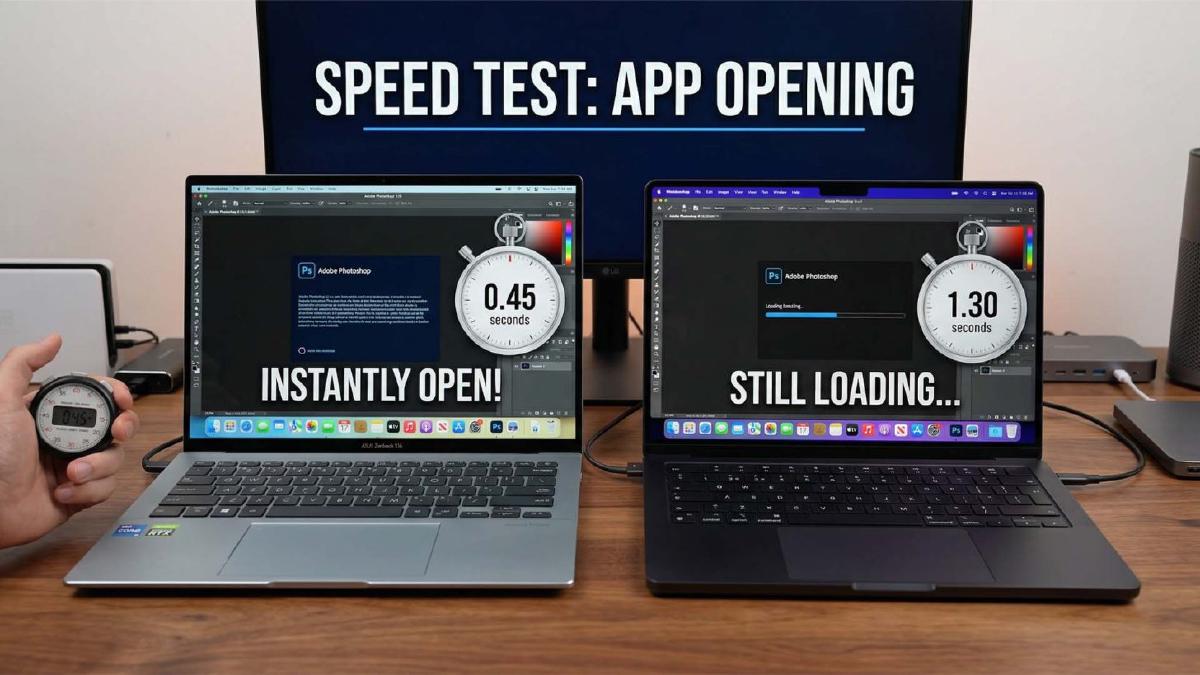
Recent comparisons have highlighted a surprising trend in the ongoing battle between Windows laptops and MacBook Pro models. As first reported by Wccftech, an owner of the latest MacBook Pro with the M3 Pro chip discovered that it lagged behind ASUS’ Zenbook S16, which features AMD’s Ryzen 9 processor, in a straightforward app opening speed test. This revelation indicates that some modern Windows machines are now closing the performance gap that had long favored Apple’s offerings.
Traditionally, Apple’s MacBook Pro line has been celebrated for its exceptional speed and efficiency, thanks in large part to the integration of Apple Silicon and optimized macOS software. The M1 and M2 series processors were pivotal in redefining what users could expect in terms of performance. However, this recent test suggests that not all versions of the MacBook Pro maintain that edge, especially when compared to newer Windows laptops equipped with cutting-edge hardware.
The speed test undertaken by the MacBook Pro owner involved opening basic applications, a routine task that many consumers engage in daily. The results showed the ASUS Zenbook S16 completed this task more swiftly than the M3 Pro MacBook. For those considering their next laptop purchase, this could be a significant factor, particularly as performance benchmarks increasingly influence buyer decisions.
Many users have long revered the MacBook Pro for its sleek design and robust performance. But as competition grows, particularly from manufacturers like ASUS, the narrative around laptop performance is beginning to change. The Zenbook S16’s impressive performance can be attributed to its advanced Ryzen 9 processor and efficient design, which appears to be resonating with users who prioritize speed.
This development is part of a broader trend where Windows laptops are increasingly matching and, in some cases, exceeding the performance of their Apple counterparts. While Apple continues to innovate with its and M3 Pro chips, the speed gap is clearly narrowing. As we see more devices enter the market with powerful processors and enhanced capabilities, the landscape of laptops is evolving, making it crucial for consumers to stay informed.
The response from the tech community has been mixed, with some praising Apple for its continued advancements while others express concern about its ability to compete with rapidly evolving Windows alternatives. As technology progresses, it raises questions about whether Apple can maintain its status as the go-to brand for high-performance laptops or if it will need to adapt further to keep pace with the competition.
For those loyal to the Apple brand, the reassurance of quality in hardware and software integration remains a compelling reason to stay with the MacBook line. However, for potential buyers weighing their options, this recent speed test serves as a reminder that there are formidable alternatives available in the Windows ecosystem.
As the landscape continues to shift, it remains essential for consumers to consider performance, speed, and value in their purchasing decisions. The competition between Mac and Windows laptops is heating up, and users are the ultimate beneficiaries of this technological rivalry.
In summary, while older MacBook Pro models have long dominated the performance scene, newer Windows laptops like the ASUS Zenbook S16 are proving they can keep pace, if not surpass, in specific benchmarks. It’s a fascinating time in the laptop industry, where innovation and competition are driving rapid advancements.
Context: ASUS is known for its innovative laptops, with the Zenbook series celebrated for its blend of performance and portability. Meanwhile, Apple’s MacBook Pro has set the standard for creative professionals, thanks to its powerful hardware and seamless software integration.
Image credit: Wccftech
This article was generated with AI assistance and reviewed for accuracy.