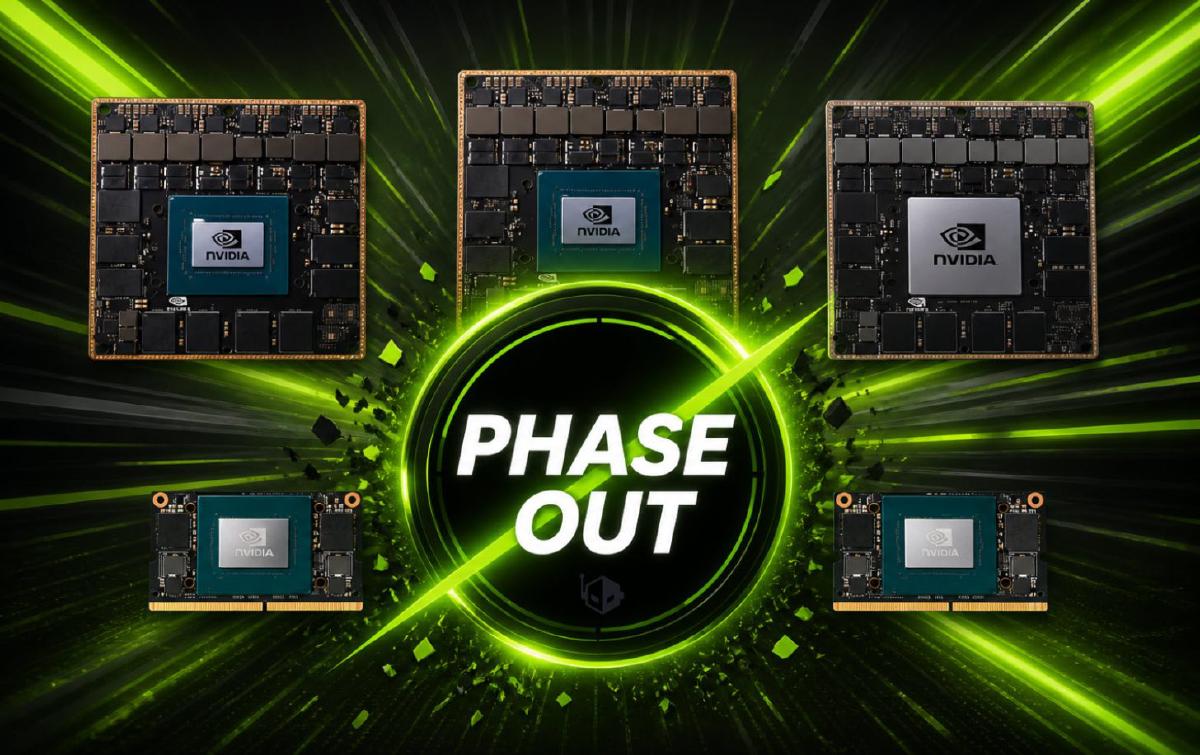
NVIDIA has announced the discontinuation of its older Jetson developer modules, a decision driven by escalating prices and supply shortages of LPDDR4 memory. As first reported by Wccftech, this move will impact various robotics and Edge AI projects that rely on these cost-effective embedded platforms.
The Jetson lineup has become synonymous with compact computing for developers, similar to what Raspberry Pi offers for hobbyists. These Single-Board Computers (SBCs) are used in a variety of applications, including autonomous vehicles, drones, and smart cameras. However, the recent turmoil in the memory market has forced NVIDIA to reconsider its offerings, leading to the phased-out status of some older modules.
These Jetson modules have been instrumental in enabling rapid prototyping and deployment of AI solutions. Each model is designed to cater to different levels of performance, but they all share a compact form factor that makes them versatile for integration into various projects. Unfortunately, the spiraling costs and limited availability of LPDDR4 memory have made it increasingly challenging for manufacturers and developers to produce and source these older models.
As NVIDIA’s partners work to transition away from these outdated modules, developers may need to look for alternatives or upgrade to newer models, which likely feature more advanced specifications but could come with increased pricing. The move highlights a broader trend in the tech sector, where supply chain disruptions and rising component costs are forcing companies to adapt quickly.
The Jetson modules have been crucial in advancing robotics and AI technologies, enabling developers to harness the power of NVIDIA’s GPU capabilities in a portable form. By phasing out older models, NVIDIA is signaling a shift towards newer technology that may offer better performance, albeit at a potentially higher price point.
The decision to discontinue these modules is a clear reflection of the current state of the semiconductor market, where memory shortages have become a significant hurdle for many manufacturers. As demand for more powerful and efficient computing solutions grows, the industry is grappling with the challenge of balancing costs and availability.
As this situation unfolds, the future of AI development using Jetson technology may hinge on how quickly supply chains can stabilize and how manufacturers adjust to the changing landscape of component availability. The discontinuation of older models marks a pivotal moment for developers who have relied on these platforms for their innovative projects.
NVIDIA’s Jetson platform, known for its robust performance in machine learning and computer vision tasks, continues to be a cornerstone in the field of robotics. As developers transition to newer hardware, NVIDIA’s commitment to advancing AI technology remains steadfast, albeit with the challenges presented by the current economic landscape.
This move by NVIDIA not only reflects the immediate market conditions but also positions the company to lead in the next generation of AI and robotics solutions, as long as they can navigate the ongoing challenges in memory supply and pricing.
Image credit: Wccftech
This article was generated with AI assistance and reviewed for accuracy.