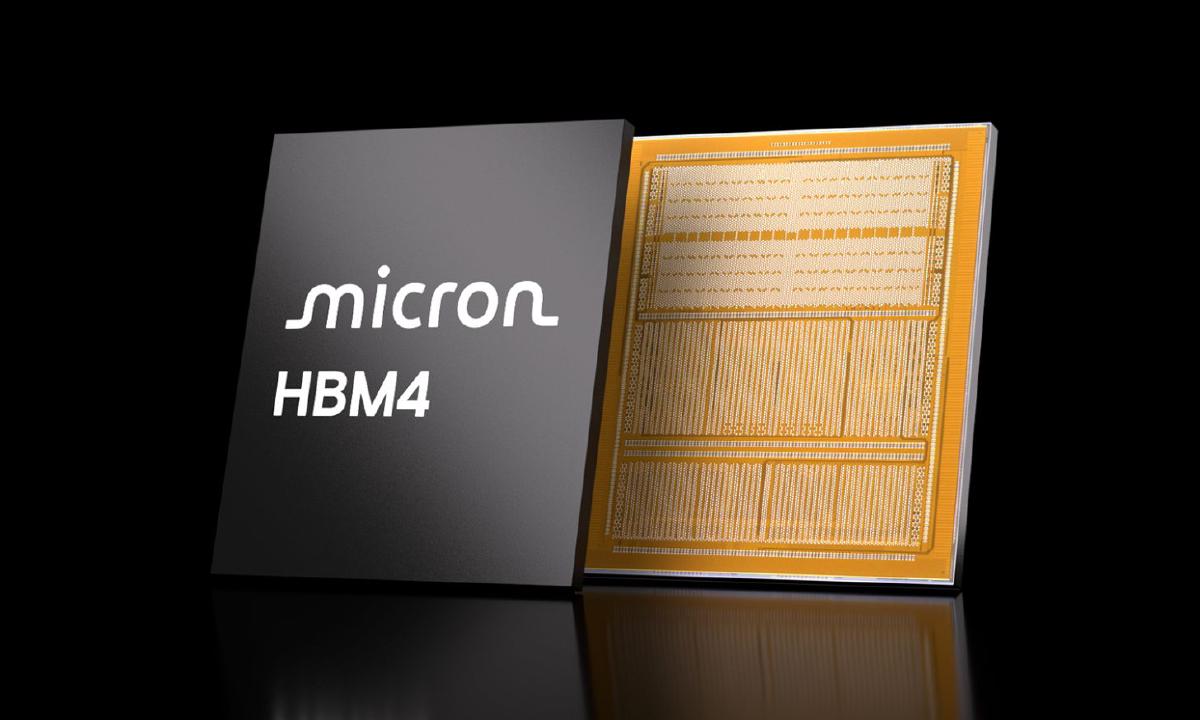
Micron Technology has officially begun volume production of its new high-bandwidth memory (HBM4) and advanced solid-state drives (SSD) tailored for NVIDIA’s Vera Rubin platform. As first reported by Wccftech, this strategic move marks a significant step towards delivering enhanced performance and efficiency in modern computing applications, particularly in graphics-intensive environments.
The new HBM4 DRAM modules will sport a capacity of 36GB and are expected to achieve impressive pin speeds exceeding 11 Gb/s. This translates to a staggering bandwidth of over 2.8 terabytes per second (TB/s), providing approximately 2.3 times the bandwidth of its predecessor, HBM3E. Additionally, Micron claims a power efficiency improvement of more than 20 percent, a critical factor for applications demanding high performance without excessive energy consumption.
In conjunction with the HBM4, Micron is also rolling out PCIe Gen6 SSDs, designed to work seamlessly with NVIDIA’s Vera Rubin architecture. This next-generation interface is poised to double the data transfer speeds compared to the previous PCIe Gen5 standard. Enhanced storage performance is essential for applications that require rapid data access and processing speed, such as in AI and machine learning workloads.
Moreover, Micron is producing SOCAMM2 memory, which is optimized for high-throughput data applications. SOCAMM2 is designed to complement the high-performance needs of the Vera Rubin platform, further pushing the boundaries of what’s achievable in data-intensive tasks.
The introduction of these components coincides with a growing demand for advanced memory solutions across various sectors, including gaming, artificial intelligence, and high-performance computing. The Vera Rubin platform is anticipated to play a vital role in the development of next-generation graphics and processing capabilities, driven by NVIDIA’s commitment to pushing graphical fidelity and computational power to new heights.
Micron’s latest offerings not only support the needs of NVIDIA’s architecture but also reflect the ongoing evolution in memory technology. With the continuous demand for faster, more efficient memory solutions, Micron’s advancements could significantly impact the way developers approach graphics and processing in their projects.
As the gaming and tech industries evolve, the synergy between advanced memory technologies like HBM4, PCIe Gen6, and SOCAMM2 will likely set new benchmarks for performance and efficiency. With mass production commencing in the first quarter of 2026, both developers and consumers are poised to benefit from the enhanced capabilities these innovations will bring.
Founded in 1978, Micron Technology is a leading provider of advanced memory and storage solutions, playing a pivotal role in driving the progress of technology across various domains, including gaming and high-performance computing.
Image credit: Wccftech
This article was generated with AI assistance and reviewed for accuracy.