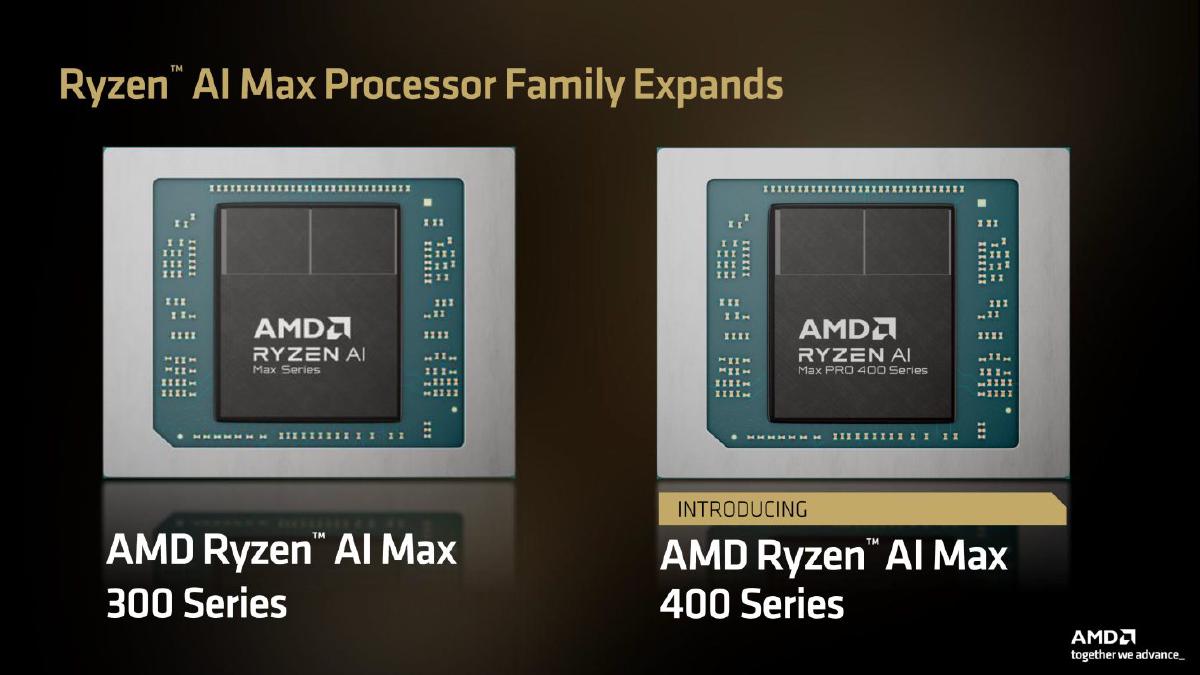
AMD has officially launched its Ryzen AI MAX 400 series of system-on-chips (SoCs), showcasing impressive capabilities that cater to the growing demand for advanced AI processing. As first reported by Wccftech, the standout feature of these new SoCs is their support for up to 192 GB of unified memory, positioning them to handle large-scale AI language models (LLMs) with over 300 billion parameters locally.
The Ryzen AI MAX 400 family, including both the Ryzen AI MAX PRO 400 and the standard Ryzen AI MAX 400, is built on the robust Zen 5 core architecture. This architecture pushes the envelope in performance and efficiency, making it particularly well-suited for AI tasks that require substantial computational resources.
In conjunction with the Zen 5 cores, the architecture integrates the RDNA 3.5 graphics technology, which significantly enhances graphical processing capabilities. This combination allows for seamless execution of complex AI algorithms while delivering high-quality visuals when needed. Furthermore, the inclusion of XDNA 2 AI neural processing units (NPUs) streamlines AI workloads, facilitating more efficient processing of large data sets.
The key innovation here, the 192 GB of unified memory, is a notable leap from previous generations. This increase in memory capacity allows single-chip setups to perform intensive calculations without relying on external solutions, thereby reducing latency and improving overall performance. With more memory available, developers and researchers can run sophisticated AI models that were previously restricted to high-end server farms or cloud platforms.
The advancements in the Ryzen AI MAX 400 series are expected to have significant implications for various sectors, including gaming, content creation, and artificial intelligence research. For gamers, the increased processing power can lead to enhanced in-game AI behaviors, improved graphics settings, and more immersive experiences. Content creators will benefit from faster rendering times and better support for real-time AI enhancements in video editing and graphic design software.
Moreover, the ability to run large AI models locally opens up new possibilities for developers. They can create and test applications that leverage advanced AI capabilities without incurring the costs and potential security risks associated with cloud computing. This could accelerate innovation across industries, especially in fields where AI is becoming an integral part of the workflow.
AMD’s push with the Ryzen AI MAX 400 series reflects its commitment to staying competitive in the rapidly evolving landscape of AI and computing technologies. With the increasing importance of artificial intelligence in modern applications, the introduction of these SoCs highlights AMD’s strategy to provide powerful solutions that meet the needs of developers and enterprises alike.
In summary, AMD’s Ryzen AI MAX 400 SoCs represent a significant milestone in the integration of AI into computing, promising to equip users with the tools needed for advanced AI applications. This release not only sets a new standard in memory capabilities but also reinforces AMD’s position as a leader in high-performance computing solutions.
AMD, known for its innovative processors and graphics cards, has been at the forefront of the tech industry for years, continually pushing the boundaries of what is possible in computing.
Image credit: Wccftech
This article was generated with AI assistance and reviewed for accuracy.