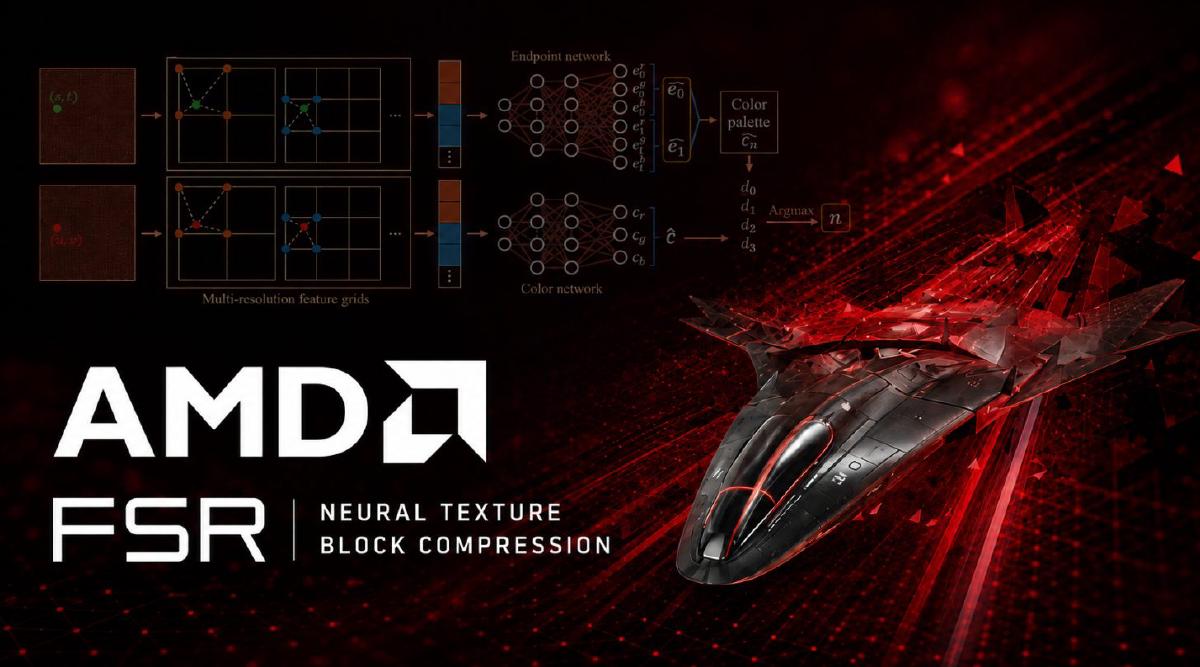
At the recent I3D Symposium, AMD unveiled groundbreaking research that could significantly enhance the field of neural texture compression. Titled “PEPS: Positional Encoding Projected Sampling,” this research proposes an innovative approach to improving the efficiency of texture encoding, achieving a 25% reduction in model parameters without sacrificing quality, as first reported by Wccftech.
Neural texture compression relies on a process known as Implicit Neural Representations (INRs). This technique learns coordinate-to-signal functions, transforming texture coordinates into a higher-dimensional embedding. By utilizing a multi-layer perceptron, developers can efficiently compress and represent textures, leading to significant improvements in rendering performance.
AMD’s PEPS method refines this process by altering how positional encoding is implemented. Traditional techniques often lead to redundancies and inefficiencies, making them less than ideal for modern gaming environments where both performance and visual fidelity are paramount. PEPS addresses these issues by optimizing the way textures are encoded, ultimately allowing for richer graphics with lower computational overhead.
The implications of this research extend beyond mere performance improvements. With the gaming industry pushing the envelope for photorealistic graphics and immersive experiences, AMD’s advancements in neural texture compression could set new standards. By reducing model parameters by 25%, developers can streamline their workflows, leaving more room for creativity while optimizing hardware resources.
This development aligns with AMD’s broader strategy to innovate in the graphics space, especially as competition intensifies with NVIDIA and other industry giants. As game developers increasingly leverage advanced graphical technologies, PEPS could serve as a critical tool, facilitating the creation of next-generation visual experiences.
AMD’s continued investment in research and development has positioned the company as a significant player in the graphics landscape. With initiatives like PEPS, AMD is not only enhancing its hardware capabilities but also contributing to the evolution of gaming technology as a whole.
With the power of neural texture compression, AMD is paving the way for titles that can feature intricate detail without compromising frame rates or load times. As developers adopt these techniques, we can expect to see not only more visually stunning games but also a more efficient development process, potentially reshaping how graphics are approached in the future.
AMD, founded in 1969, has a long-standing history in the semiconductor market and is recognized for its innovative advancements in microprocessors and GPUs. The company’s commitment to research helps drive the gaming industry forward, ensuring that it remains at the cutting edge of technology and graphical fidelity.
Image credit: Wccftech
This article was generated with AI assistance and reviewed for accuracy.