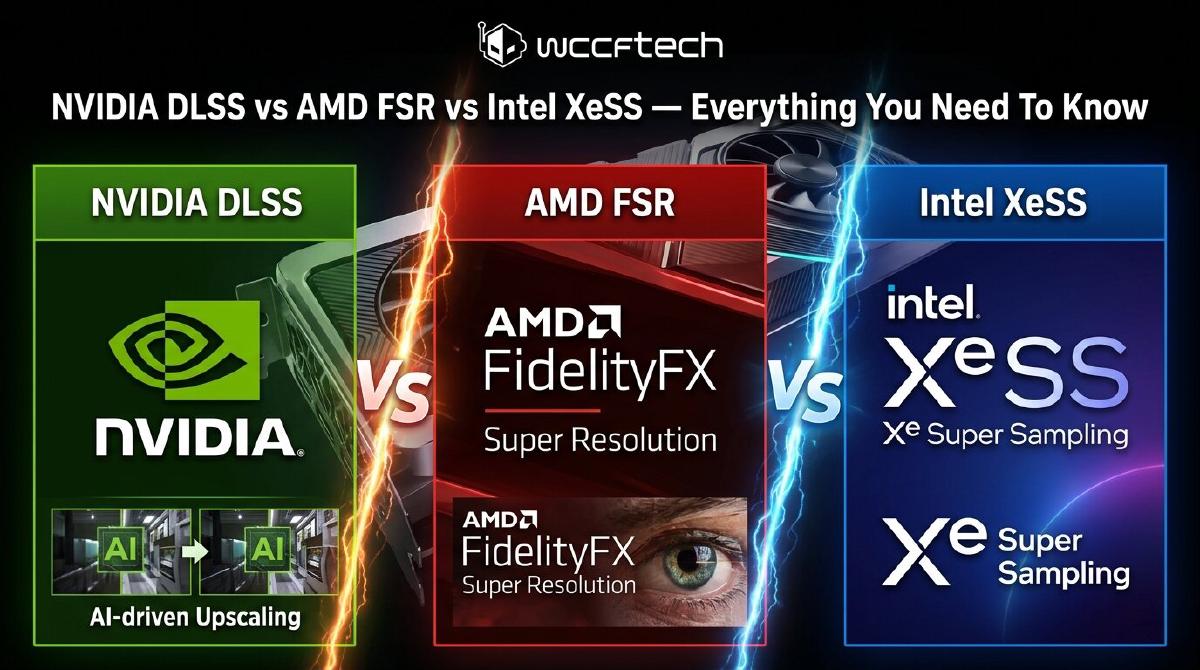
The ongoing quest for higher visual fidelity in gaming comes with its challenges, especially regarding performance. As reported by Wccftech, GPU manufacturers NVIDIA, AMD, and Intel have rolled out advanced technologies designed to tackle these challenges effectively. At the heart of this evolution are three key technologies: NVIDIA’s Deep Learning Super Sampling (DLSS), AMD’s FidelityFX Super Resolution (FSR), and Intel’s Xe Super Sampling (XeSS). These solutions not only enhance performance but also elevate the overall graphics experience through innovative upscaling and denoising techniques.
Real-time graphics rendering has advanced significantly over the past decade. It now incorporates elements like ray tracing and path tracing, which have brought unprecedented realism to video games. However, the demand for higher graphical fidelity often strains hardware resources, challenging gamers to maintain smooth framerates. The introduction of neural rendering and image reconstruction technologies addresses this issue by employing advanced algorithms for temporal upscaling and frame generation, thus providing smoother visuals without the need for significant hardware upgrades.
NVIDIA’s DLSS leverages artificial intelligence to upscale lower-resolution images in real time, effectively allowing games to run at higher quality levels without the corresponding performance hit. This technology is particularly effective in ray-traced environments, where rendering demands peak. DLSS analyzes game frames, generating additional pixels based on the data it has learned from previous frames, offering a seamlessly enhanced visual experience.
In contrast, AMD’s FSR operates on a slightly different principle. Rather than relying on deep learning, FSR utilizes a spatial upscaling technique that quickly processes frames to provide a visually appealing output. The latest iteration, FSR 2.0, includes temporal elements that allow for better motion handling and image clarity, especially in fast-paced sequences. With wide compatibility across various platforms and hardware, FSR aims to provide a performance boost without the need for specialized hardware.
Intel’s XeSS enters the arena with its own unique approach. It seeks to combine the advantages of both NVIDIA and AMD technologies while also being optimized for Intel’s own architecture. Utilizing machine learning to enhance the upscaling process, XeSS focuses on denoising effects, particularly in ray-traced scenarios. This allows for higher frame rates while maintaining detail levels that would otherwise be lost in traditional upscaling methods.
Each of these technologies has its strengths and weaknesses, and the best choice for gamers often depends on their specific hardware and gaming preferences. For instance, NVIDIA’s DLSS shines on systems equipped with RTX GPUs, while AMD’s FSR is widely praised for its versatility across a range of graphics cards, including older models. Intel’s XeSS, although newer to the market, is growing in adoption and promises to provide competitive performance as more games adopt the technology.
As the landscape of GPU technology continues to evolve, it’s crucial for gamers to keep informed about the capabilities of these technologies to make the best decisions for their setups. The advancements made in neural rendering and image reconstruction are set to redefine what is possible in gaming graphics, offering smoother, more immersive experiences.
NVIDIA, founded in 1993, has long been a pioneer in graphics processing units, while AMD has been a strong competitor, focusing on balancing performance with affordability. Intel, traditionally known for CPUs, has entered the GPU market with a fresh perspective, aiming to innovate within the space.
The ongoing competition between these companies ensures that gamers will benefit from continuous improvements in performance and visual quality, making every new title an opportunity to experience the latest in cutting-edge technology.
Image credit: Wccftech
This article was generated with AI assistance and reviewed for accuracy.